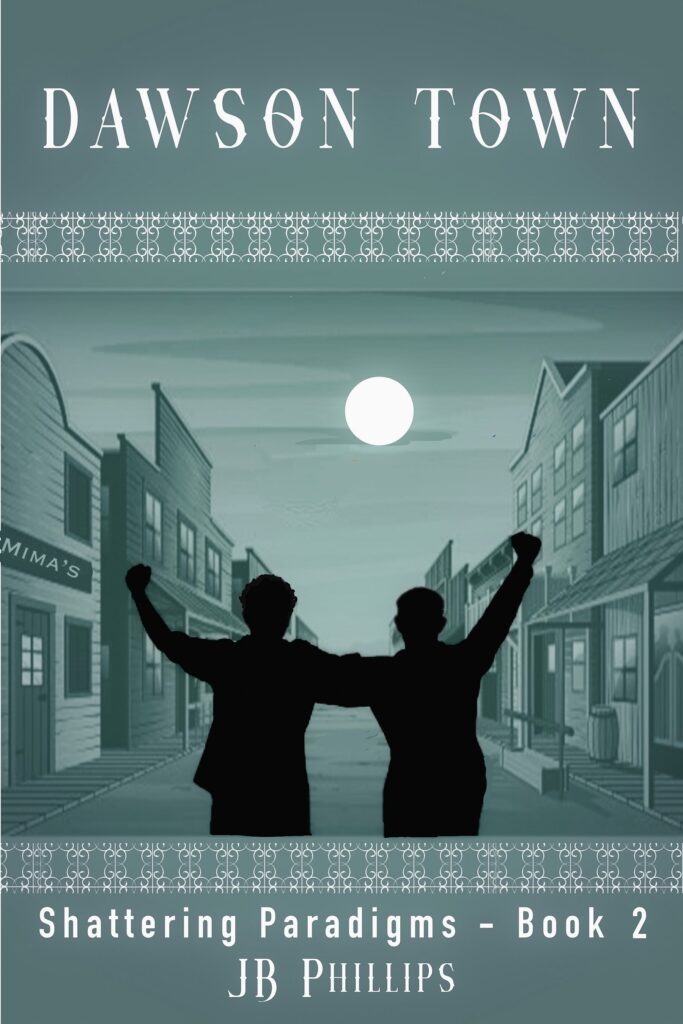
Dawson Town: Shattering Paradigms, Book 2
What would you do to defend your freedom?

Following the emancipation of slaves in Texas, twenty-year-old plantation owner Samuel Dawson faces new challenges. The state government is reticent to recognize social and political equality between Blacks and whites. Many Texans are determined to return the state to white dominance, threatening the thriving community that Samuel has built.

Both whites and freedmen seek refuge in Dawson Town, eager to take advantage of the opportunity to build a better life for themselves and their families. Former slaves start successful businesses to meet the needs of the growing population.

President Johnson and Democrats advocate treating the rebellious Confederate states leniently. Radical Republicans demand that those states only be re-admitted to the Union if they recognize the natural rights of Blacks. To bolster support for the Republicans, Samuel and his best friend, Will, embark on a whistle-stop tour of New England and the Midwest with the renowned abolitionist Frederick Douglas.

As the fight for racial equality intensifies, Samuel is elected as a delegate to a constitutional convention, where he faces fierce opposition in his efforts to extend suffrage to Blacks. Undeterred, he challenges his fellow delegates to visit Dawson Town and witness the progress and potential that can be achieved when the rights of all individuals are recognized and protected.

Dawson Town is an inspiring tale of courage, determination, and the fight for justice in a time of great turmoil. For fans of historical fiction and stories of triumph over adversity, this book is a must-read. This is a story of what could have been and should have been.

Dawson Town is available on Amazon.

Click here to read Chapter 1 of Dawson Town for FREE.

Similar Posts

  • Friday Roundup 5-28-21

    In a post about systemic racism, John McWhorter writes: A science teacher conference in Washington state last year included a PowerPoint slide preaching that “If you conclude that outcome differences by demographic subgroup are a result of anything other than a broken system, that is, by definition, bigotry.” This should have been corrected: “If you…

  • We Don’t Need Adjectives for Justice

    It has become increasingly popular to add adjectives to “justice.” This has led to “social justice,” “racial justice,” environmental justice,” and now, “housing justice.” As an example, Casey Dawkins, Professor of Urban Studies and Planning at the University of Maryland, claims that we must develop a new understanding of justice as it applies to housing….

  • |

    The Color of Law

    In recent years we have heard a great deal of criticism regarding the economic and racial segregation of America’s cities. While much has been written on the subject, The Color of Law: A Forgotten History of How Our Government Segregated America by Richard Rothstein provides an illuminating explanation as to why this has occurred. Much…

  • Racism, Cartels, and Jim Crow

    This was originally posted on Live Oaks on December 26, 2010. Comments have not been migrated. It is often claimed that capitalism leads to all sorts of ills, such as racism and cartels (or monopolies). As with most attacks on capitalism, these claims attempt to blame capitalism for the consequences of government intervention into the…

  • Greed and Justice

    “Avarice,” states a recent editorial in the Houston Chronicle, “is just a politer way of describing greed, which seems to be the fuel behind President Trump’s idea to bypass Congress to give yet another tax break to wealthy investors like himself.” And taxation is just a politer way of describing legalized theft. The editorial goes…

  • A License to Steal?

    Law enforcement agencies and prosecutors claim that civil asset forfeiture (CAF) is a crucial tool in fighting the “war on drugs.” CAF allows law enforcement agencies to seize property suspected of being involved in a crime. The Texas Tribune recently published a story that examines CAF in four Texas counties. Interestingly, in about 40 percent…